Mastering a Hyaluronic Acid Hydration Routine is the ultimate foundation for transforming dehydrated, tight-feeling skin into a supple, dewy complexion. In Korean skincare, achieving true radiance is not merely about slathering on heavy occlusive creams; it relies on layering multi-depth moisture deep within the epidermal layers. When implemented correctly, hyaluronic acid works as a biological water reservoir, plumping surface fine lines and restoring natural elasticity.
Before restructuring your daily regimen, evaluating whether your skin lacks water or produces excess oil is essential. Check our foundational guide on Dehydrated Skin vs Oily Skin: 5 Essential Secrets to Find Your Skin Type to accurately diagnose your skin condition. Furthermore, if you want to understand how deep hydration fits into a traditional Korean regimen, explore our complete breakdown of the 10-Step K-Beauty Skincare Routine: 5 Ultimate Secrets to Flawless Glass Skin.
By understanding how humectants bind water molecules to skin tissue, you can eliminate dehydration lines permanently. Here are 5 proven secrets to optimize your Hyaluronic Acid Hydration Routine every single day.
1. What is Hyaluronic Acid? The Ultimate Moisture Magnet
Hyaluronic Acid (HA), documented scientifically as Hyaluronic acid, is a naturally occurring glycosaminoglycan found throughout human connective tissue, joint fluid, and the dermis. It possesses the extraordinary capability to attract and retain up to 1,000 times its molecular weight in water, making it an indispensable active ingredient in modern dermatological science.
Understanding Multi-Molecular Weights:
To maximize efficacy, advanced K-beauty formulations combine different molecular sizes of hyaluronic acid rather than relying on a single weight:
- High Molecular Weight HA: Remains on the skin surface, forming an invisible, breathable moisture film that protects against transepidermal water loss (TEWL) and environmental dry air.
- Medium Molecular Weight HA: Penetrates into middle epidermal layers, hydrating intercellular spaces and smoothing rough surface texture.
- Low & Micro Molecular Weight HA: Reaches deep into dermal layers, stimulating cellular hydration, plumping fine dehydration lines, and boosting underlying firmness.
2. The Golden Rule: Always Apply to Damp Skin
The most common reason people experience tightness after using hyaluronic acid is improper application. As a humectant, hyaluronic acid functions like a sponge—it pulls moisture from its surrounding environment into the skin.
If you apply an HA serum onto bone-dry skin in a low-humidity room, the molecule may draw water upward from the deeper layers of your dermis, leaving your surface feeling tighter and more dehydrated than before.
The Secret Solution: Always mist your face with water, thermal spray, or a hydrating botanical toner before and immediately after applying your serum. Providing ambient moisture ensures the hyaluronic acid binds abundant external water directly to your epidermis.
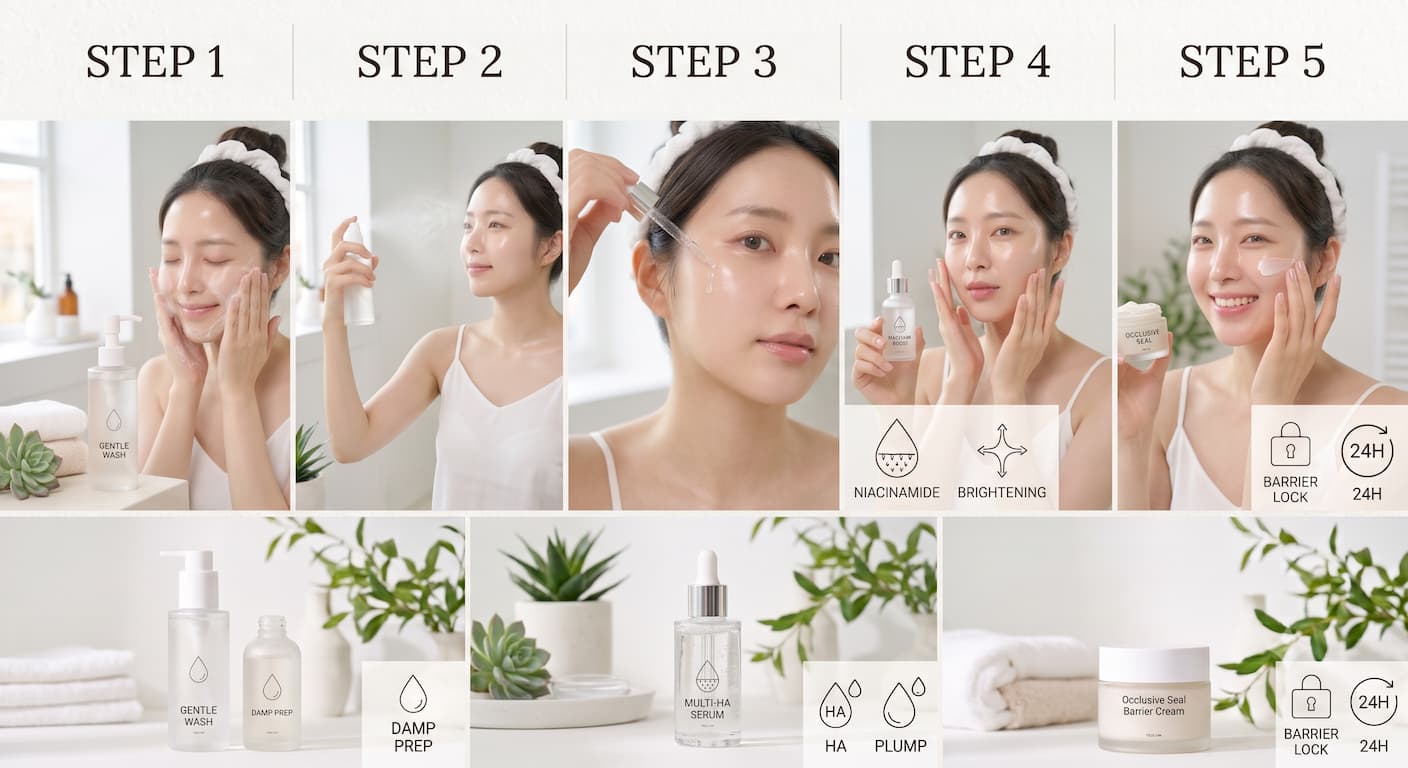
3. The 5-Step Hyaluronic Acid Hydration Routine
To maximize clinical-grade hydration without clogging pores or overwhelming your moisture barrier, follow this step-by-step daily sequence:
[Step 1: Gentle Wash] ➔ [Step 2: Damp Prep] ➔ [Step 3: Multi-HA Serum] ➔ [Step 4: Niacinamide Boost] ➔ [Step 5: Occlusive Seal]
Step 1: Gentle Non-Stripping Cleansing
Start with a mild, low-pH cleanser that sweeps away impurities without stripping natural surface lipids. Avoid harsh sulfates that break down your protective lipid barrier.
Step 2: Prep with a Hydrating Facial Mist
Generously mist clean skin with a hydrating toner or thermal water. Leaving the skin visibly damp creates the ideal water-rich environment for humectant absorption.
Step 3: Layer Your Multi-Depth HA Serum
Dispense 3 to 4 drops of a multi-molecular hyaluronic acid serum. Gently press and pat the formula into damp skin using your fingertips rather than rubbing vigorously.
Step 4: Amplify with Synergistic Actives
Pair your hyaluronic acid with brightening and barrier-strengthening ingredients. To see how combining humectants with niacinamide dramatically improves overall radiance, read our detailed guide on Hyaluronic Acid and Niacinamide: 5 Proven Secrets for Radiant Glass Skin.
Step 5: Seal in Moisture with an Occlusive Barrier Cream
Humectants require an occlusive layer to trap bound water inside the skin. Finish your routine with a nourishing barrier moisturizer rich in ceramides, squalane, or panthenol to seal in deep hydration for up to 24 hours.
4. Perfect Ingredient Synergies for Glass Skin
While hyaluronic acid is a powerhouse on its own, pairing it with complementary active ingredients elevates your skin results to the next level:
- Hyaluronic Acid + Ceramides: While HA draws water into skin cells, ceramides rebuild the lipid matrix that keeps water locked inside, preventing evaporation.
- Hyaluronic Acid + Panthenol (Pro-Vitamin B5): Panthenol acts as both a humectant and an anti-inflammatory agent, soothing irritation while HA boosts skin volume.
- Hyaluronic Acid + Glycerin: Combining multiple humectants creates a multi-layered moisture trap that ensures round-the-clock suppleness.
5. Common Hyaluronic Acid Mistakes to Avoid
💡 Essential Hydration Checklist:
- Never Skip the Moisturizer: Leaving hyaluronic acid exposed to dry indoor air without an occlusive sealing cream causes water evaporation.
- Mind the Climate: In extremely dry or desert climates, use a room humidifier at night to give humectants airborne water to pull from.
- Layer Thinly: Applying multiple light, watery layers yields far superior hydration than applying a single thick, sticky glob of high-viscosity serum.
Final Thoughts (Hyaluronic Acid Hydration Routine)
Implementing a structured Hyaluronic Acid Hydration Routine is a game-changer for transforming dull, dehydrated skin into a plump, radiant complexion. By combining multi-molecular HA with damp application techniques and sealing lipids, you can maintain healthy, glowing glass skin every day.